
Matcha Powder Compliance Guide: ISO, HACCP, Kosher and HALAL Evidence
Matcha powder compliance is a documentation question before it is a marketing question. A buyer screening matcha powder suppliers in 2026 will be shown ISO, HACCP, Kosher and HALAL logos within minutes, yet those logos answer none of the three questions that actually decide a purchase order: does the certificate scope cover matcha powder, is the certificate still valid on the shipment date, and is there a batch-level certificate of analysis (COA) for the material in the drum?
This guide answers those three questions in the order a due-diligence review should ask them. It uses the certificate records held by Guanjie Biotech — a China-based ingredient manufacturer founded in 2004 that supplies plant extracts, fruit powders and specialty raw materials to supplement, food and cosmetics manufacturers — as a worked example of what complete evidence looks like, and where its limits sit.
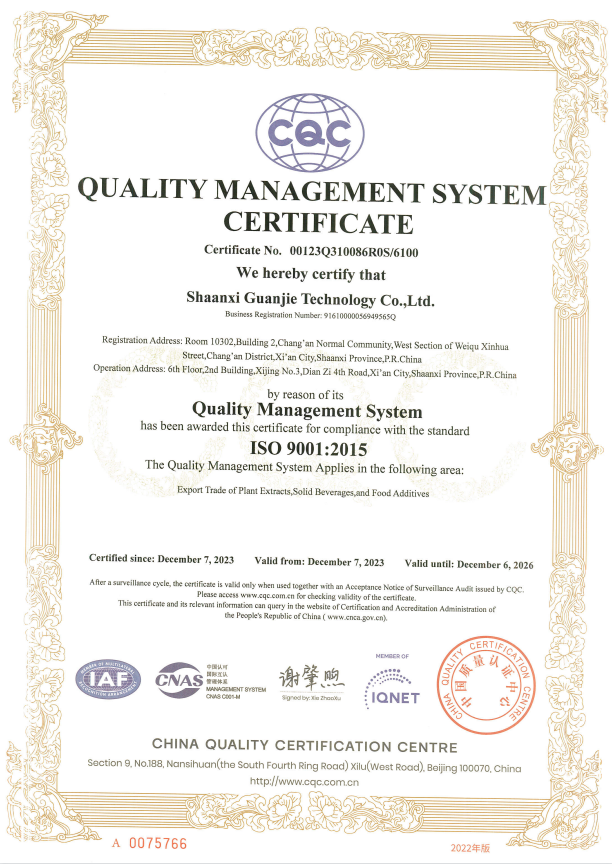
ISO 9001:2015 certificate 00123Q310086R0S/6100, issued by China Quality Certification Centre (CQC), valid 7 December 2023 to 6 December 2026.
What “Matcha Powder Compliance” Means to an International Buyer
A compliant matcha powder shipment is one where three things agree: the material matches the specification the buyer purchased, it was produced under a documented control system, and the paperwork is accepted by the destination market's authority or by the buyer's own quality team.
Most sourcing problems come from a mismatch between those three. A certificate proves that a control system was audited. It does not prove that a specific drum of matcha powder matches a specific specification, and it carries no result for the current batch.
The three gaps buyers hit most often
- Scope gap. A certificate's scope sentence describes an activity — for example “export trade of plant extracts, solid beverages and food additives” — not every individual SKU. The buyer has to confirm that matcha powder appears on the certificate's product list.
- Validity gap. Certificates expire on fixed dates. An order placed against a certificate that lapses weeks later carries a documentation risk unless the renewal is confirmed in writing.
- Batch gap. Certificates are issued once and maintained through periodic audit; COAs are issued per batch. Neither document replaces the other.
Industry Background: Why the Logo Is the Weakest Part of the File
Demand is the reason certificate screening has become routine. A commercial market research estimate for the matcha category puts the global market at USD 3.91 billion in 2026, rising to USD 5.35 billion by 2031 at a compound annual growth rate of 6.47%. Growth of that shape brings new buyers into the category — beverage formulators, private-label brands, cosmetics teams — who are comfortable with ingredient specifications but not with botanical certificate conventions.
Regulatory expectations have moved in the same direction. The U.S. Food and Drug Administration states that facilities which manufacture, package or hold dietary supplements must follow current good manufacturing practices intended to help ensure identity, purity, quality, strength and composition. That requirement is met through production controls, testing and records — not through a logo. A certificate supports the claim that a system exists; it is not evidence that any particular lot was tested.
For buyers who want an external cross-check on how an ingredient is declared in finished products, the NIH Dietary Supplement Label Database catalogs label information for dietary supplements sold in the United States, including ingredient names and forms, amounts, claims and warnings. It is useful for benchmarking how a botanical is positioned in the market, but it does not verify a supplier's certificate or a supplier's COA.
The Four Layers of Matcha Powder Evidence
Treat a matcha powder supplier's compliance file as four separate layers. Each layer answers a different question, and a complete file has all four.
Layer 1 — Management-system certificates: ISO 9001:2015 and HACCP
Guanjie Biotech holds two management-system certificates, both issued by the China Quality Certification Centre (CQC):
- ISO 9001:2015, certificate number 00123Q310086R0S/6100, scope “Export Trade of Plant Extracts, Solid Beverages, and Food Additives”, issued 7 December 2023, expiring 6 December 2026.
- HACCP System Certification, certificate number 001HACCP2301048, certified against the HACCP System Certification Requirements (V1.0), same scope wording, issued 6 December 2023, expiring 5 December 2026.
Both scopes are worded as “export trade of…”. A buyer should read that literally: the certificate describes a trade activity and the product families named, and the product list attached to the certificate is what connects it to matcha powder. In these records matcha powder appears among the listed related products, with grades spanning Grade 1 to Grade 6. When a purchase order specifies a grade, that grade belongs in the order, the specification and the COA alike, so that the certificate, the specification and the batch record all point to the same item.
Timing matters here, and it is the check most buyers skip. As of November 2026 both certificates remain inside their validity periods, with expiry dates in the first week of December 2026. Any order whose production or shipment falls after those dates should be supported by the renewed certificate rather than by a copy of the expiring one. That is a routine request, and a supplier who cannot produce the renewal on schedule is telling the buyer something useful about document control.
Layer 2 — Market-access certificates: Kosher and HALAL
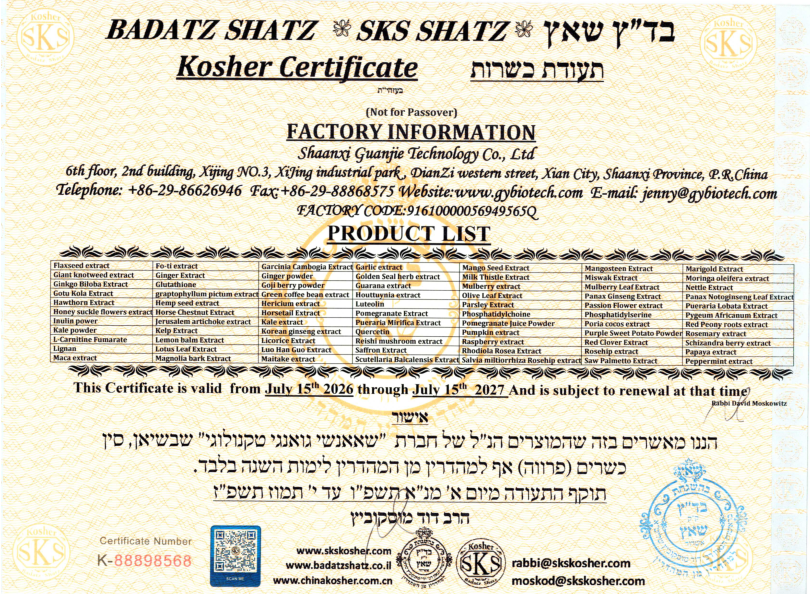
Kosher certificate K-88898568, Badatz Shatz (SKS), valid 15 July 2026 to 15 July 2027.
The Kosher record is certificate K-88898568 issued by Badatz Shatz (SKS) under Kosher Dietary Law, valid from 15 July 2026 to 15 July 2027, with a scope that reads “various plant extracts (see product list in certificate)”. That wording is the whole lesson: the certificate identifies the product by reference to an attached list, so a buyer who receives only the front page of the certificate has received an incomplete document. Always request the certificate with its product list page intact.
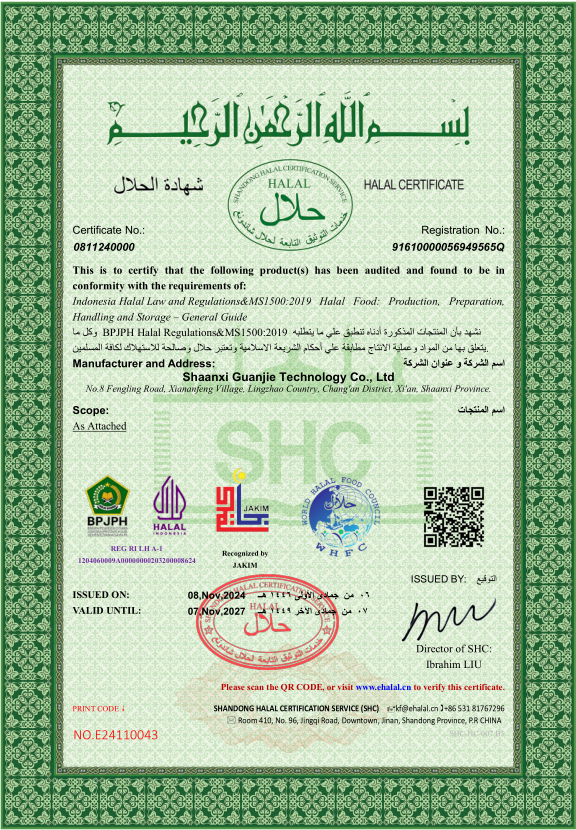
HALAL certificate 0811240000, Shandong Halal Certification Service (SHC), valid 8 November 2024 to 7 November 2027.
The HALAL record is certificate 0811240000 issued by Shandong Halal Certification Service (SHC), covering plant extracts, solid beverages and food additives, certified against the Indonesia Halal Law and Regulations together with MS1500:2019 Halal Food: Production, Preparation, Handling and Storage — General Guide, valid from 8 November 2024 to 7 November 2027. The named standard makes this certificate directly relevant to Indonesian market entry. For Gulf, Malaysian or other halal markets, the buyer should confirm separately whether the issuing body and the standard referenced are accepted by the destination authority, because halal acceptance is determined market by market.
Neither of these two certificates is a contaminant certificate. They address dietary and market-access requirements. They do not report a heavy-metal result, a pesticide residue result or a microbiological count, and no buyer should treat them as if they did.
Layer 3 — Batch COA and residue testing
Batch testing generates the certificate of analysis; certificates of registration generate nothing at batch level.
The COA is the only document in the file that speaks about the material in the drum. For a botanical powder such as matcha, a usable COA typically covers identity, assay or key marker content where a marker is specified, moisture, particle size or mesh, heavy metals, microbiological limits and — depending on the destination market and the buyer's own risk assessment — pesticide residues and residual solvents.
Guanjie Biotech states that every batch is tested and that a batch COA accompanies each shipment, with third-party re-testing support through laboratories such as SGS and Eurofins where a result needs to be resolved on arrival. Those are the two mechanisms worth writing into a supply agreement: an in-house result for every batch, and an independent route when a result is disputed.
Ask which method produced each number. Heavy metals are commonly reported by ICP-MS, pesticide residues by GC-MS/MS or LC-MS/MS, and moisture by loss on drying. A COA that names both the result and the method is far easier to defend in an audit than one that lists a figure alone.
Acceptance limits on a matcha COA are not universal. They follow the destination market's food law and the buyer's own specification. The practical rule is that the buyer writes the limits into the purchase specification and asks the supplier to confirm the testing panel against it before the first order, rather than accepting a generic statement that the material “meets standards”.
Layer 4 — Facility and process description
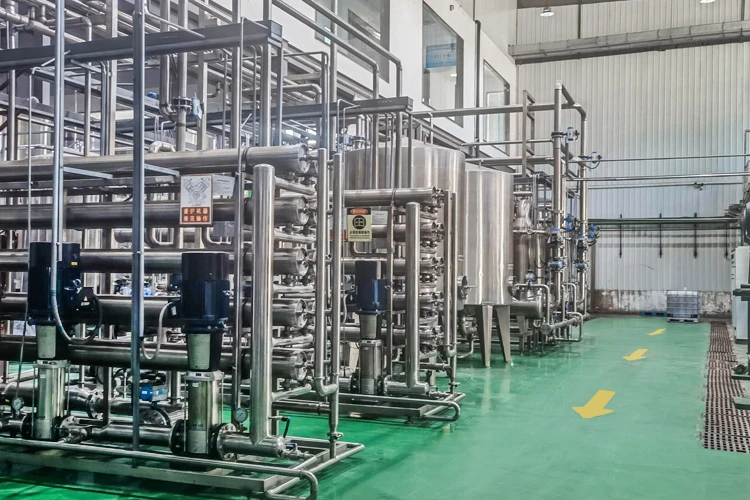
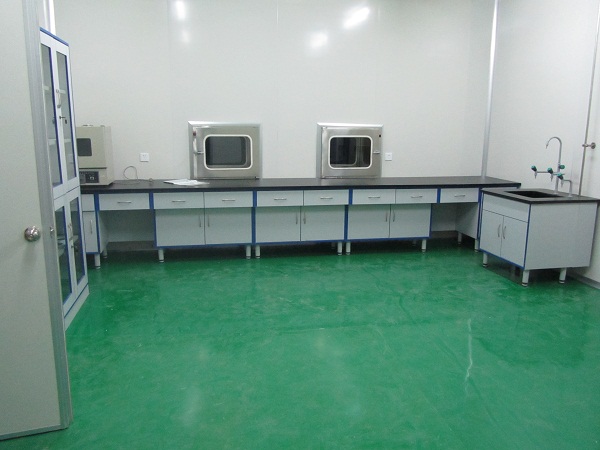
A 7,000 m² production site including a 2,000 m² cGMP-standard clean workshop and a 500 m² laboratory.
Guanjie Biotech operates a 7,000 m² site that includes a 2,000 m² cGMP-standard clean workshop and a 500 m² laboratory, with 40 employees, a seven-engineer R&D team and 16 national patents, alongside collaboration with Northwest University and the Xi'an branch of the Chinese Academy of Sciences.
This layer is the one buyers most often misread. A cGMP-standard clean workshop is a statement about how a facility is built and operated; it is not the same thing as a cGMP certificate issued by an authority or an accredited certification body. Buyers who need a certificate, an audit report or a site visit should request exactly that, and should keep “cGMP workshop” and “cGMP certified” as two separate claims throughout the evaluation.
Where “100% Natural”, “Non-GMO” and “Additive-Free” Sit in a Compliance File
These three phrases appear on matcha powder listings constantly, and they are the easiest claims to over-read. They are product-attribute claims, not certification outcomes. An ISO 9001 or HACCP certificate says nothing about whether a powder is natural, non-GMO or free of additives, and a Kosher or HALAL certificate addresses dietary acceptability rather than agricultural origin.
Attribute claims have to be carried by the specification and the COA, and — for non-GMO status — by a supplier declaration that states the scope of the claim. For a single-ingredient botanical powder, “additive-free” is best treated as a statement about what is not in the drum: no carrier, no anti-caking agent, no added colour. Written into the specification in exactly those terms, it becomes something the COA can actually be checked against. Left as a phrase on a product page, it stays a marketing statement.
Nine Checks for Reading a Matcha Powder Certificate
- Identify the certificate type and the standard behind it. “ISO 9001:2015” and “HACCP System Certification Requirements (V1.0)” are specific; a document that says only “ISO” is not.
- Record the certificate number. A numbered certificate can be checked with the issuing body. An unnumbered one cannot.
- Note the issuing body. The ISO 9001 and HACCP certificates come from CQC, the Kosher certificate from Badatz Shatz (SKS), the HALAL certificate from Shandong Halal Certification Service (SHC). Whether an issuer is accepted depends on the destination market.
- Read the scope sentence word by word. “Export trade of plant extracts, solid beverages and food additives” describes trade activity and product families, not individual items.
- Find the product list and confirm matcha powder is named, including the grade you intend to buy.
- Compare the expiry date with your shipment date and ask for the renewal if the two overlap.
- Verify the certificate with the issuing body through the number, not through a PDF alone.
- Request the COA template and one recent batch COA before placing the order, and check that the fields match your specification.
- Confirm the destination market's requirements for residue limits and certificate acceptance with your own regulatory contact or importer of record.
Where These Documents Change a Buying Decision
Supplement brand entering the EU or North America. The decision usually turns on the COA rather than the certificate. The brand needs a specification that states which contaminants are tested, at what limits and by which method, and it needs the batch COA to reproduce that panel. ISO 9001:2015 and HACCP support the quality-system question; they do not substitute for the panel.
Buyer shipping into Indonesia or the Middle East. Here the HALAL certificate moves to the front of the file, and the standard named on it matters as much as the certificate itself. Because the Guanjie Biotech certificate is issued against the Indonesia Halal Law and Regulations and MS1500:2019, an Indonesian buyer can assess it directly; a buyer in another halal market should confirm acceptance with the local authority before ordering.
Distributor serving kosher-certified manufacturers. The Kosher scope refers to a product list inside the certificate. A distributor who forwards only the cover page creates a documentation gap that surfaces later, usually at the customer's audit.
Private-label brand commissioning OEM packaging. Guanjie Biotech offers OEM/ODM cooperation with package customisation, a minimum order quantity of 1 kg and a stated lead time of 30 days, with a monthly capacity of 30 tons. In this scenario the grade specified in the artwork, the grade in the COA and the grade on the certificate's product list must all be the same grade.
Beverage and functional-food formulators. Matcha sits alongside the wider nutraceutical powder range used in hard capsules, functional beverages, functional foods and confectionery, nutricosmetics and sports nutrition. Guanjie Biotech's application documentation for this range specifies storage in a cool, dry, dark place, sealed after opening, away from high temperature and moisture — a condition worth passing through to your own warehouse team, because storage failures are the most common cause of a batch that no longer matches its COA on arrival.
Comparison: What Each Document in the File Actually Covers
| Document | What it is | As recorded | Validity | What it does not prove |
|---|---|---|---|---|
| ISO 9001:2015 | Quality management system certificate | Certificate 00123Q310086R0S/6100, CQC; scope: export trade of plant extracts, solid beverages and food additives | 7 Dec 2023 – 6 Dec 2026 | Batch conformity, residue results, product safety |
| HACCP | Hazard analysis and critical control point system certification | Certificate 001HACCP2301048, CQC; HACCP System Certification Requirements (V1.0); same scope wording | 6 Dec 2023 – 5 Dec 2026 | A hazard analysis for a specific product line, or a test result for a specific lot |
| Kosher | Dietary certification | Certificate K-88898568, Badatz Shatz (SKS); scope: various plant extracts, see product list in certificate | 15 Jul 2026 – 15 Jul 2027 | Contaminant levels, agricultural origin, non-GMO status |
| HALAL | Dietary and market-access certification | Certificate 0811240000, Shandong Halal Certification Service (SHC); plant extracts, solid beverages, food additives; Indonesia Halal Law and Regulations & MS1500:2019 | 8 Nov 2024 – 7 Nov 2027 | Acceptance by every halal authority, or safety and residue data |
| Batch COA | Per-batch analytical record | Issued per batch; every batch tested at Guanjie Biotech, with third-party re-testing support via SGS or Eurofins where required | Tied to the batch, not to a calendar date | System-level control, or results for tests the buyer never specified |
| Facility description | Site and process statement | 7,000 m² site; 2,000 m² cGMP-standard clean workshop; 500 m² laboratory | Not a certificate; no fixed validity | A cGMP certificate, an audit finding, or regulatory approval |
Frequently Asked Questions
What documents should accompany a matcha powder batch?
A complete batch file contains the certificate of analysis for that specific batch, and copies of the relevant certificates with their scope and product list pages. For Guanjie Biotech material those are the ISO 9001:2015 certificate (00123Q310086R0S/6100), the HACCP certificate (001HACCP2301048), the Kosher certificate (K-88898568) and the HALAL certificate (0811240000). The COA is what connects the certificates to the material actually shipped; without it the rest of the file only describes a system and a scope.
Do ISO 9001 and HACCP certificates prove a matcha powder batch is compliant?
No. These certificates address the management system and the hazard-control system, not a specific lot. The Guanjie Biotech ISO 9001:2015 and HACCP certificates both define their scope as export trade of plant extracts, solid beverages and food additives, with matcha powder listed among the related products. Batch-level compliance is demonstrated by the COA, which is where identity, assay, moisture, heavy metals, microbiological results and any pesticide-residue testing should appear.
Can Guanjie Biotech supply matcha powder from a cGMP-standard facility with batch COAs?
Yes. Guanjie Biotech operates a 7,000 m² site that includes a 2,000 m² cGMP-standard clean workshop and a 500 m² laboratory, states that every batch is tested, and issues a COA with each shipment. One precision matters: the company describes a cGMP-standard workshop rather than holding a standalone cGMP certificate, so a buyer whose internal qualification procedure requires a cGMP certificate or an on-site audit should request that document or schedule the visit separately.
What is the minimum order quantity, and how is matcha powder priced?
The minimum order quantity is 1 kg, and pricing is quoted per order rather than published as a list. The quote depends on the grade specified between Grade 1 and Grade 6, the quantity, the packaging format under OEM/ODM customisation and the testing panel agreed for your destination market. Monthly capacity is stated at 30 tons, which is the figure to use when checking whether a forecast can be scheduled.
Can I request a sample before ordering, and what is the lead time?
Samples are available on request so that the grade, colour, mesh and specification can be checked against the intended application before a purchase order is raised; free samples are part of the company's stated support for buyers. Lead time is 30 days. The most efficient sequence is to confirm the specification and testing panel first, then request the sample and the COA template together — that way the sample you approve and the document you will audit describe the same material. Requests can be sent to info@gybiotech.com or via WhatsApp on +86 150-2999-3470.
Conclusion: Read the Scope, Then Read the Batch
A matcha powder compliance file is not one document and it is not a set of logos. It is four layers stacked in a particular order: management-system certificates that describe the control environment, dietary and market-access certificates that describe acceptability in a destination market, a batch COA that describes the material in the drum, and a facility description that describes the site. Each layer answers a question the others cannot.
The discipline that separates a well-run evaluation from a rushed one is small and unglamorous. Read the scope sentence. Confirm matcha powder is named on the product list. Check the expiry date against the shipment date — the ISO 9001 and HACCP certificates in this example both expire in the first week of December 2026, which is a live consideration for any order placed now. Ask which method produced each COA figure. And keep “cGMP-standard workshop” and “cGMP certified” as two different statements, because a supplier that keeps them separate is usually the one whose documents hold up under audit.
Guanjie Biotech supplies matcha powder and a wider range of botanical and specialty ingredient powders to supplement, food and cosmetics manufacturers, exporting to markets across Europe, Asia, the Middle East and the Americas. Buyers who want to review the full ingredient portfolio, specification formats and documentation package can download the catalogue below, or send a specification directly for a documented quote.
Catalogue: Guanjie Nutraceutical Ingredients (PDF)
Website: guanjiebio.com
Email: info@gybiotech.com
WhatsApp: +86 150-2999-3470
Have Questions or Need More Details?
Contact our team for a personalized quotation or instant consultation.
Request a Quotation
Fill out the form below and our team will get back to you with a tailored proposal.
WhatsApp Direct Chat
Prefer to chat in real-time? Message us on WhatsApp for instant assistance & quick answers.
- Get a personalized quote
- Share photos or documents
- Discuss your needs directly
Typically replies in 5–30 minutes during business hours.