Matcha Powder Compliance Pack: ISO, HACCP, Kosher, HALAL and Test Evidence
A matcha powder compliance pack is the document set a supplier can hand to a buyer, a contract manufacturer or a market-entry reviewer and expect it to survive a line-by-line reading. For Guanjie Biotech matcha powder, Grades 1 to 6, that pack is built from four certificates — ISO 9001:2015, HACCP, Kosher and HALAL — together with batch test evidence for heavy metals and pesticide residues, and the process facts that make the product description traceable: hot-air drying, low-temperature ultra-fine grinding and a 100.0% pass rate at 80 mesh.
This page is narrower than a general certificate explainer. It maps each document in the pack to the questionnaire line it actually answers, records the certificate numbers, issuing bodies, standards and expiry dates a buyer will be asked to supply, and marks clearly where the paperwork stops. Buyers researching nutraceutical ingredients often find that the real gap is not the certificate itself but the distance between what the certificate covers and what the questionnaire assumes it covers.
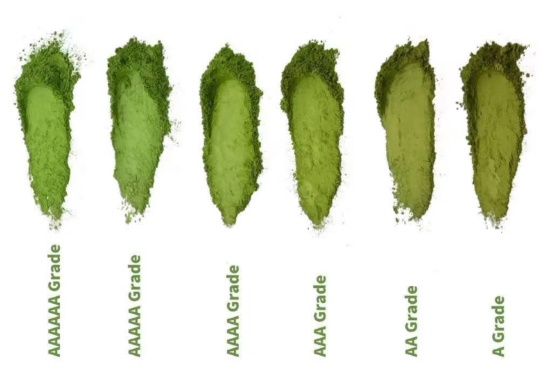
Matcha powder is supplied in Grades 1 to 6; the grade determines which specification sheet applies to a given batch.
What the compliance pack contains
The pack has three layers, and each layer answers a different kind of question from a buyer.
- Management-system and scheme certificates. ISO 9001:2015, certificate 00123Q310086R0S/6100, issued by the China Quality Certification Centre (CQC); HACCP, certificate 001HACCP2301048, also issued by CQC; Kosher, certificate K-88898568, issued by Badatz Shatz (SKS); and HALAL, certificate 0811240000, issued by Shandong Halal Certification Service (SHC).
- Product-level documents. A specification sheet for the grade actually supplied, and a Certificate of Analysis (COA) for the batch, covering purity, moisture, heavy metals, microbial limits and active ingredients.
- Process and claim statements. Hot-air drying technology, low-temperature ultra-fine grinding, the 100% natural and additive-free positioning, the non-GMO positioning, and the stated 100.0% pass at 80 mesh.
Layers one and two are auditable: they carry a certificate number, an issuing body and an expiry date, or a measured result tied to a specific lot. Layer three is descriptive. That distinction is where most questionnaires go off track, because a process description and a claim statement are frequently treated as though they carried the same weight as a numbered certificate.
The buyer problem: questionnaires ask for documents, not adjectives
A matcha powder questionnaire typically combines four unrelated demands in one spreadsheet: a market-entry requirement, a quality-system requirement, a product-safety requirement and a commercial requirement. The rows look similar — each asks for “evidence” — but they are satisfied by different documents with different owners and different expiry logic.
The first failure mode is scope drift. A certificate covering “export trade of plant extracts, solid beverages and food additives” is a genuine, verifiable document, but it is not a statement that every individual product grade has been separately approved. Quoting it as blanket product approval overstates the evidence and creates a discrepancy a serious buyer will find during document review.
The second failure mode is date drift. Certificates expire, and a compliance file assembled during sampling can be out of date by the time a purchase order is issued. The third failure mode is claim substitution: an adjective in a product brochure (“non-GMO”, “additive-free”) is copied into a regulatory column of the questionnaire as though it were a certificate reference. Each of these is avoidable with a pack that states its own boundaries.
Industry background: why matcha sits across several document regimes
Matcha is used well beyond the tea category. In the supplied application data, functional powders of this type are formulated into hard capsules, tablets, softgels and powder sachets, functional and fortified beverages, functional foods and confectionery, nutricosmetics and personal care, and sports nutrition products. A single ingredient therefore meets buyers whose questions come from food-safety, supplement-quality and dietary-certification angles at the same time.
Regulatory expectations reinforce that. The U.S. Food and Drug Administration states that those who manufacture, package or hold dietary supplements must follow current good manufacturing practice requirements intended to help ensure identity, purity, quality, strength and composition. That statement describes a regulatory obligation; it is not evidence that any particular supplier complies. Supplier-specific certificates, batch records and test reports remain the documents a buyer has to collect and verify.
Against that background, the four certificates in this pack do different jobs. ISO 9001:2015 addresses quality management, HACCP addresses hazard analysis and critical control points, Kosher addresses compliance with kosher dietary law, and HALAL addresses halal requirements under the standards named on the certificate. None of them substitutes for another, and a buyer who treats them as interchangeable will end up with a file that looks complete and answers nothing.
The four certificates, document by document
ISO 9001:2015 — quality management system
The ISO 9001 certificate in the pack is numbered 00123Q310086R0S/6100, issued by the China Quality Certification Centre (CQC) against the ISO 9001:2015 standard. Its stated scope is the export trade of plant extracts, solid beverages and food additives, and it is recorded with an issue date of 7 December 2023 and an expiry date of 6 December 2026.
For a buyer, this certificate answers the questionnaire line that asks whether the supplier operates a certified quality management system, and it gives a verifiable reference number and issuer for that claim. It does not, by itself, describe the manufacturing process of a specific lot, and the scope wording should be read literally and quoted accurately in the buyer's own file.
One practical detail matters more than usual here: the recorded ISO 9001 expiry date falls in December 2026. A buyer assembling a compliance file now should confirm the current validity and any renewal status directly with the supplier before the certificate is used to support a shipment or a market-entry submission, rather than assuming the copy in the file is still active.
HACCP — hazard analysis and critical control points
The HACCP certificate is numbered 001HACCP2301048, issued by the China Quality Certification Centre (CQC) against the HACCP System Certification Requirements (V1.0). Its stated scope matches the ISO certificate — export trade of plant extracts, solid beverages and food additives — with an issue date of 6 December 2023 and an expiry date of 5 December 2026.
This is the document that answers the food-safety row of a questionnaire: it demonstrates that a hazard analysis and critical control point system has been certified for the stated scope. It is a system certificate, not a laboratory report. The batch-level answer to a contamination question is still the COA, which reports the measured values for that lot.
Kosher — Badatz Shatz (SKS)
The Kosher certificate is numbered K-88898568, issued by Badatz Shatz (SKS) under kosher dietary law, with an issue date of 15 July 2026 and an expiry date of 15 July 2027. The scope entry reads “various plant extracts (see product list in certificate)”.
That wording carries an instruction. The certificate covers a listed set of products, so a buyer should confirm that the specific matcha grade being purchased appears on the certificate's product list, and should keep that list in the compliance file alongside the certificate itself. A kosher certificate without the corresponding product list answers a different question from the one the buyer is asking.
HALAL — Shandong Halal Certification Service
The HALAL certificate is numbered 0811240000, issued by Shandong Halal Certification Service (SHC) against the Indonesia Halal Law and Regulations and MS1500:2019 (Halal Food: Production, Preparation, Handling and Storage — General Guide). It is recorded with an issue date of 8 November 2024 and an expiry date of 7 November 2027, and its market entry is listed as global coverage including the Middle East, Indonesia and other halal markets. The stated scope is plant extracts, solid beverages and food additives.
For halal-channel buyers, this is the certificate that closes the dietary-compliance line of the questionnaire, and the standard reference is worth recording exactly: MS1500:2019 together with the Indonesian halal framework, rather than a generic “halal certified” note.
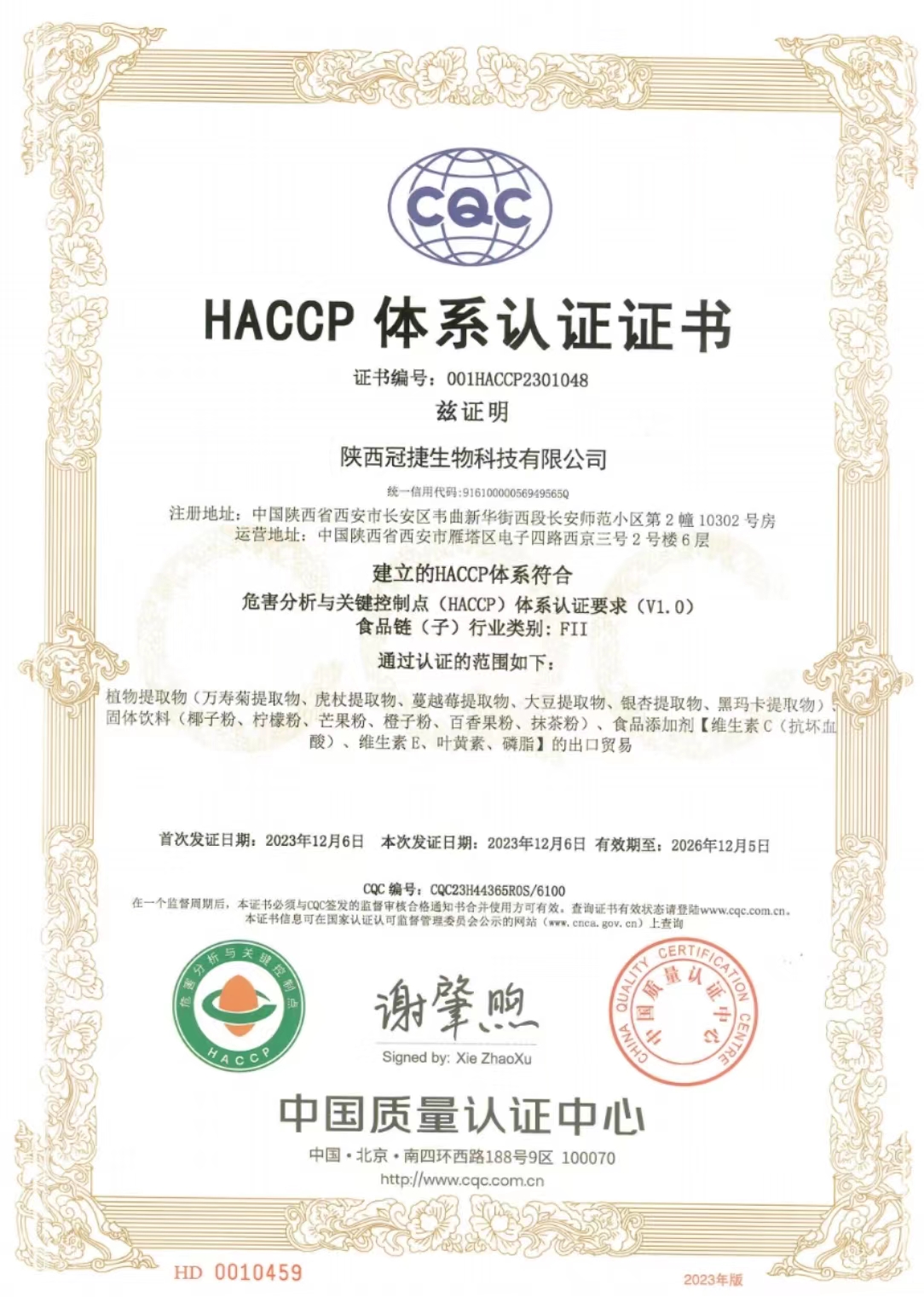
The HACCP certificate covers the export trade of plant extracts, solid beverages and food additives, with a stated expiry of 5 December 2026.
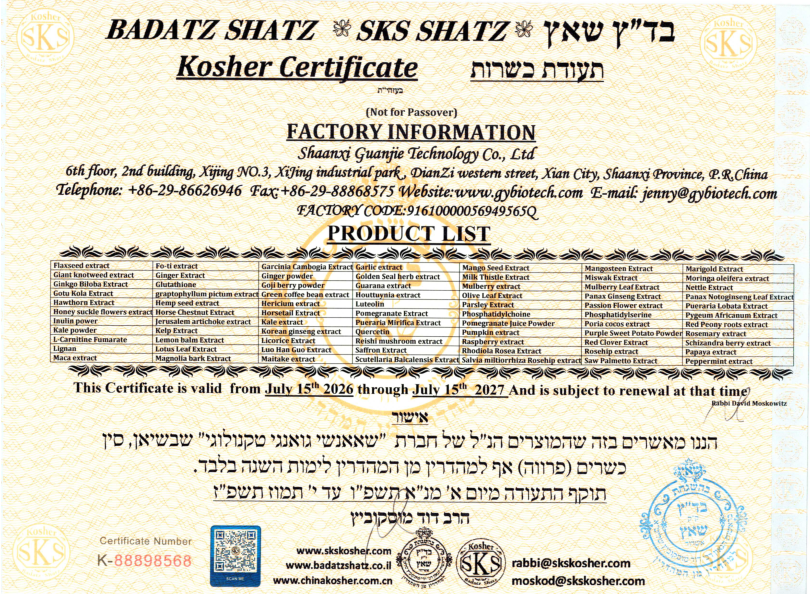
The kosher scope refers to a product list inside the certificate, which should be checked against the grade being purchased.
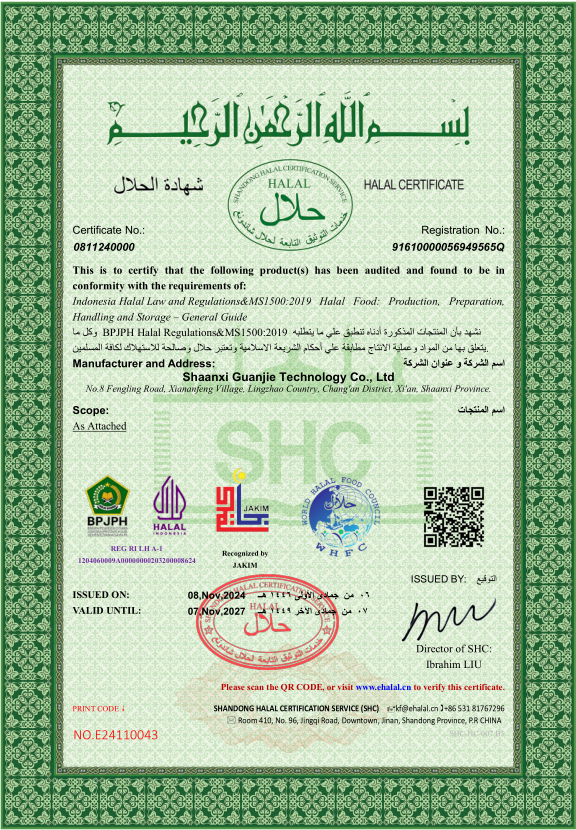
The halal certificate names MS1500:2019 and the Indonesian halal framework as its standards basis, valid to 7 November 2027.
Test evidence: heavy metals, pesticide residues and the 80-mesh figure
The product description for Guanjie Biotech matcha powder states rigorous testing for heavy metals and pesticide residues, and the supplier's quality-control arrangement is described as 100% testing with a complete Certificate of Analysis issued for every shipment, matching pre-shipment specifications that include purity, moisture, heavy metals, microbial limits and active ingredients.
What the supplied record does not publish is equally important to know in advance: it does not list numeric heavy-metal limits, the specific test method, or the reporting unit used for each analyte. Those are specification decisions that appear on the batch COA. A buyer should therefore request the COA for the actual lot, confirm the limits and methods written on it against the destination market's own requirements, and avoid transcribing a marketing sentence about “rigorous testing” into a regulatory column where a measured value belongs.
What the 100.0% pass at 80 mesh does and does not measure
Matcha powder in this pack is specified at 100.0% pass through 80 mesh, with a green powder appearance and hot-air drying as the stated technology. The figure is a particle-size classification result: it states that the whole of the tested material passed an 80-mesh sieve, not that the material is 100% pure, sterile or contaminant-free.
Its buyer value is practical rather than regulatory. Sieve-pass data is what a formulator needs when the powder goes into a dry blend, a sachet or a ready-to-drink mix, because particle size affects dispersion behaviour and blend uniformity. When a questionnaire asks about particle size or mesh, the correct answer is the 80-mesh pass figure plus the test basis; when it asks about purity or contaminants, the correct answer is the assay and the COA, not the mesh number.
Process traceability: hot-air drying and low-temperature ultra-fine grinding
Two process facts in the record give the specification a manufacturing context. The powder is produced using hot-air drying technology and then low-temperature ultra-fine grinding. The product description states that this low-temperature grinding route is used to maximise solubility and to protect heat-sensitive antioxidants, including the EGCG and L-theanine content associated with shade-grown green tea leaf material.
Read strictly, this is a process description, not a validated retention study, and it should be presented that way in a buyer file. Its value is traceability: it tells a reviewer how the physical specification — fine mesh, green colour, solubility behaviour — is produced, and it gives the buyer a specific process question to raise during a supplier audit instead of a generic quality question.
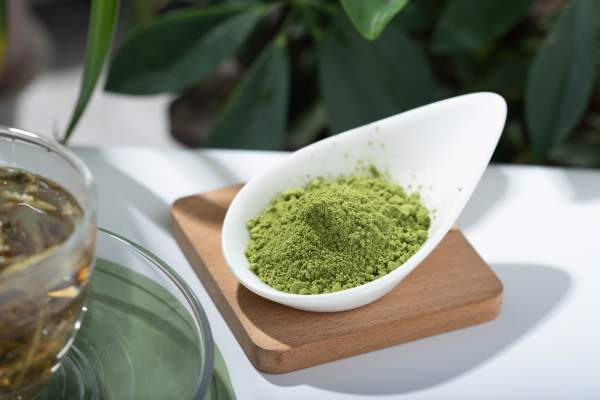
Particle-size evidence in the pack is the 100.0% pass at 80 mesh; purity and contaminant answers come from the batch COA.
Step-by-step: aligning the pack with a buyer questionnaire
The work of matching documents to questions is mechanical once the questionnaire is sorted. The sequence below keeps each claim attached to the document that actually supports it.
- Sort the questionnaire into four columns. Separate market-entry or legal questions, quality-system questions, product-safety and specification questions, and commercial questions. Documents from one column cannot answer another.
- Assign one document to each row. ISO 9001:2015 for the quality-management row, HACCP for the food-safety system row, Kosher and HALAL for the dietary-scheme rows, the specification sheet for grade, appearance and mesh, and the batch COA for measured values.
- Record the identity fields in full. Certificate number, issuing body, standard reference, stated scope, issue date and expiry date. Partial references such as “ISO certified” are unverifiable and will usually be queried.
- Test the scope wording against your own transaction. If the certificate scope is limited to export trade of certain product categories, quote it that way and add the product-list check where the certificate requires one — as the kosher certificate does.
- Run the expiry check against your shipment window. Two certificates in this pack carry December 2026 expiry dates, so confirm current validity before quoting them in a submission that will be reviewed later.
- Convert adjectives into documented language. Where the pack contains a certificate, cite it. Where it contains only a product-description statement, present it as a supplier statement and say so.
- Version and re-verify. Store the pack with the date it was assembled, and re-check certificates and COAs at each order rather than reusing an old file.
Comparison table: what each document supports
| Document | Issuer / reference | Standard or basis | Validity as recorded | Supports | Does not establish |
|---|---|---|---|---|---|
| ISO 9001:2015 | CQC; 00123Q310086R0S/6100 | ISO 9001:2015 | Issued 2023-12-07; expires 2026-12-06 | Certified quality management system for the stated scope | Lot-level test results; product approval in any market |
| HACCP | CQC; 001HACCP2301048 | HACCP System Certification Requirements (V1.0) | Issued 2023-12-06; expires 2026-12-05 | Certified hazard analysis and critical control point system for the stated scope | Microbial or heavy-metal results for a specific batch |
| Kosher | Badatz Shatz (SKS); K-88898568 | Kosher dietary law | Issued 2026-07-15; expires 2027-07-15 | Kosher status of the products listed inside the certificate | Coverage of grades not on the certificate product list |
| HALAL | SHC; 0811240000 | Indonesia Halal Law and Regulations; MS1500:2019 | Issued 2024-11-08; expires 2027-11-07 | Halal compliance for plant extracts, solid beverages and food additives within scope | Approval by any specific national halal authority |
| Batch COA | Supplier, per shipment | Pre-shipment specification | Tied to the specific lot | Measured purity, moisture, heavy metals, microbial limits, active ingredients | Future lots; anything outside the tested analytes |
| Product specification | Supplier | Grade 1 to Grade 6 lines | Current specification version | Appearance, 100.0% pass 80 mesh, hot-air drying process route | Safety clearance or certificate equivalence |
Use cases: which document a buyer reaches for first
A beverage brand building a clean-label file. The first questions are usually product-level: grade, appearance, mesh and solubility behaviour, followed by the COA for the trial lot. The certificates complete the file, but they do not start it.
A supplement manufacturer whose questionnaire includes a dietary-scheme row. Here the kosher and halal certificates lead, and the product-list check on the kosher certificate becomes a real task rather than a formality. The COA still governs the safety rows.
A contract manufacturer running a dry blend. The 100.0% pass at 80 mesh and the batch-to-batch consistency statement carry most of the technical weight, because blend uniformity and dispersion depend on the physical specification before anything else.
An importer preparing a market-entry submission. Certificate identity fields — number, issuer, standard, scope and expiry — are the first things a reviewer checks, and two certificates in this pack expire in December 2026, so a current copy is part of the submission, not an afterthought.
Where the pack stops: stating boundaries without weakening it
A compliance pack is more credible when it names its own limits. Four boundaries belong in the buyer file alongside the documents.
- The non-GMO positioning is a product-description statement in the supplied record, not a separate certificate. A buyer whose questionnaire requires a non-GMO certificate should raise it as a document request rather than listing it as already evidenced.
- The 100% natural and additive-free positioning is similarly a specification statement. It belongs in the product column, next to the ingredient list and the COA, not in a certification column.
- Numeric heavy-metal and pesticide-residue limits, test methods and reporting units are not published in the supplied record. They are set on the batch COA and should be read from it.
- Certificates cover stated scopes and dates. They are management-system, food-safety and dietary-scheme certifications, not market authorisations, and they do not transfer from one product grade to another without checking the accompanying list.
Handled this way, the boundaries do not weaken the pack. They make it usable in a review, because a reviewer can see which statement is certified, which is measured and which is descriptive.
Frequently asked questions
Which documents should accompany each matcha powder batch from a cGMP nutraceutical ingredients manufacturer?
At minimum: a batch Certificate of Analysis covering purity, moisture, heavy metals, microbial limits and active ingredients; the specification sheet for the grade supplied; and the four scheme certificates — ISO 9001:2015 (00123Q310086R0S/6100), HACCP (001HACCP2301048), Kosher (K-88898568) and HALAL (0811240000) — each with issuer, scope and expiry date. The COA is the only document that speaks to the specific lot; the certificates speak to systems and schemes.
Does ISO 9001 or HACCP certification make a supplier cGMP compliant?
No. ISO 9001:2015 certifies a quality management system and HACCP certifies a hazard analysis and critical control point system, each within a stated scope. Current good manufacturing practice is a separate regulatory framework — the U.S. FDA states that supplement manufacturers, packagers and holders must follow cGMP requirements, and that requirement does not certify any individual supplier. What the supplier record adds here is a facility description: a 7,000 m² site that includes a 2,000 m² cGMP-standard clean workshop and a 500 m² laboratory built to GMP and QS standards, as described by the company. Buyers should pair that description with audit documentation and batch records.
How do I align the certificate pack with a market-entry request without overstating it?
Quote each document at its own strength. Use the certificate number, issuer and standard reference when citing a certificate; use the COA when citing a measured value; and label description-level claims as supplier statements. Check the scope wording against your own transaction — for example, the ISO and HACCP scopes read “export trade of plant extracts, solid beverages and food additives”, and the kosher scope refers to a product list inside the certificate. Confirm that matcha appears on that list, and record the expiry date next to every certificate you submit.
What test evidence backs the matcha powder specification?
The product description states rigorous testing for heavy metals and pesticide residues, and quality control is described as 100% testing with a COA issued per shipment. The physical specification is 100.0% pass at 80 mesh, produced through hot-air drying and low-temperature ultra-fine grinding. Because the supplied record does not publish numeric contaminant limits or methods, buyers should confirm those values on the batch COA rather than assuming them from the description.
What are the ordering terms — MOQ, lead time and customization?
The supplier capability record lists a minimum order quantity of 1 kg, a lead time of 30 days and a monthly capacity of 30 tons, with OEM/ODM support that includes packaging customization and export coverage across the EU, Middle East, North America, South America and Asia. Those terms make a small trial feasible before scale-up. Pricing is quoted per grade, quantity and delivery term rather than published, so it is requested against a specification.
Conclusion: a pack that can be checked, not just presented
The matcha powder compliance pack is strongest where it is most specific: a named ISO 9001:2015 certificate with a CQC issuer and a December 2026 expiry, a HACCP certificate under the V1.0 requirements, a kosher certificate whose product list has to be opened, a halal certificate citing MS1500:2019 and the Indonesian framework, a COA issued per shipment, and a physical specification of 100.0% pass at 80 mesh produced through hot-air drying and low-temperature ultra-fine grinding.
For a buyer in the research and evaluation stage, the practical rule is simple: put every questionnaire line next to the document that actually answers it, record the identity fields in full, check scope and expiry against the transaction in front of you, and keep description-level claims labelled as descriptions. A pack assembled that way holds up when a reviewer reads it closely — and it tells you what to request next rather than leaving you to assume.
Guanjie Biotech (guanjiebio.com) supplies matcha powder alongside a wider nutraceutical ingredients portfolio, with batch COAs, scheme certificates and third-party re-testing support available for buyer review. The full ingredient catalogue, including specification lines for plant extracts and powder products, can be downloaded from the company brochure: Guanjie Nutraceutical Ingredients brochure.

Sample requests, specification sheets and certificate copies for matcha powder can be requested against the grade and destination market.
Have Questions or Need More Details?
Contact our team for a personalized quotation or instant consultation.
Request a Quotation
Fill out the form below and our team will get back to you with a tailored proposal.
WhatsApp Direct Chat
Prefer to chat in real-time? Message us on WhatsApp for instant assistance & quick answers.
- Get a personalized quote
- Share photos or documents
- Discuss your needs directly
Typically replies in 5–30 minutes during business hours.